As an experienced provider of injection molding machines, I often get asked about injection weight.
To begin, it is vital to understand that injection weight is all about the stroke and diameter of the screw, as well as the temperature difference in the barrel and injection pressure. Let’s delve into this subject to shed more light on it.
The injection weight of an injection molding machine signifies the maximum quantity of injection that can be reached during a single maximum injection stroke of the screw.
For statistical convenience, the weight of PS (polystyrene) plastic is typically used as the standard due to the diverse densities of various plastics.
Now, let’s explore this concept further.
During the entire injection molding process, the density of the plastic raw material alters in accordance with the changes in temperature and pressure.
As the owner of Haichen, a factory that specializes in producing injection molding machines, I have seen these changes firsthand.
How do different types of plastics impact the injection weight?
Two main types of plastics significantly impact injection weight: Amorphous and Crystalline plastics.
Amorphous plastics like PC, ABS, and PS have a density change of about 7%. Meanwhile, Crystalline plastics like PE, PP, and PA show an even more significant density change, roughly 15% – 20%.
This difference results in a discrepancy in the measured volume of raw materials during plasticization compared to the volume of products at room temperature and pressure.
What influences the injection quality of a machine?
During injection, the molten material flows back into the screw groove, check ring, etc., impacting the injection quality.
In this regard, the injection quality of a machine can be calculated as:
W=Vc* αβ P= Vc* K * P= Vc* * P’
- W – Injection weight (g)
- Vc – Theoretical injection volume
- α- Density correction coefficient, determined by plastic type and process conditions
- β- Leakage correction coefficient of plasticizing device
- P-Density of plastic products at room temperature
- K-injection coefficient
- P ‘- Corrected calculated density
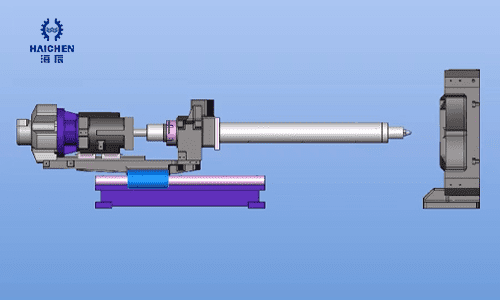
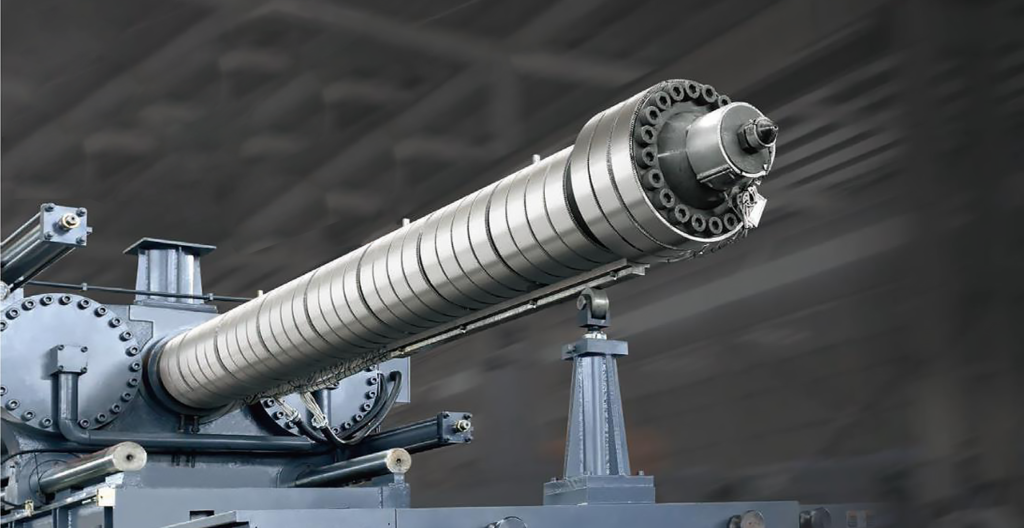
Here at Haichen, our machine’s injection weight is largely determined by the stroke and diameter of the screw.
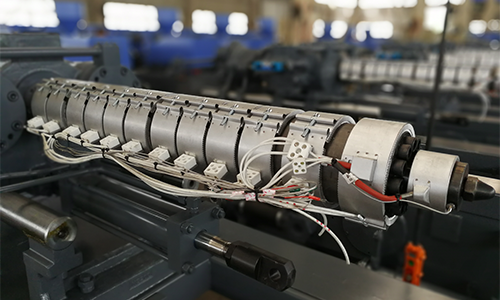
What is the Relationship Between Stroke, Diameter, and Injection Weight?
The stroke (S) is directly associated with the axial temperature difference of the molten material in the barrel, while the diameter bears a direct relation to the injection pressure.
Drawing from our years of experience at Haichen, we can assert that for standard screws, the maximum stroke should generally hover around 3.5D.
This configuration allows for a smaller diameter screw to yield higher injection pressure, resulting in a more compact structure.
Nevertheless, some injection devices demonstrating superior plasticization performance may exhibit a screw stroke closer to 5D.
After determining the ratio of screw stroke to diameter K (x=S/D), one can estimate the screw diameter and calculate its weight. The formula is as follows:
D3=4Vc/πK=4W/aβρπ*K=4W/ρ’πK
How does the Injection Volume Impact the Weight of Plastic Products?
When operating an injection molding machine, it’s crucial to understand that the weight of the plastic products processed typically falls within the range of 1/4-4/5 of the machine’s injection volume.
Ideally, this should not dip below 1/10. If the injection volume is too small, it not only hampers the machine’s full utilization but also undermines the product’s performance.
This is because the prolonged retention of plastic in the material barrel can easily lead to thermal decomposition.
Conversely, if the volume is too large, it may fail to fill the cavity entirely, which can lead to issues like insufficient fullness.
In conclusion, the injection weight is a fundamental aspect to consider when operating injection molding machines.
It is influenced by multiple factors, including the stroke and diameter of the screw, and the types of plastics used.
By understanding these concepts, you can better optimize your use of injection molding machines, and ultimately improve the quality and efficiency of your production.
Here at Haichen, we are committed to providing you with the most advanced and efficient injection molding machines. We are always ready to answer any further questions you may have about injection weight or any other aspect of injection molding. Don’t hesitate to get in touch with us for more information.